- This event has passed.
Sprinkler systems extinguish fires in extra-care living accommodation in Croydon and Abergavenny, strengthening the argument for making them statutory.
1 July 2025 - 31 December 2025

Background
The benefit of installing Automatic Water Suppression Systems (AWSS) protecting the most vulnerable residents of our communities was clearly demonstrated following reported dwelling kitchen fires by the London Fire Brigade and South Wales Fire and Rescue Service involving extra care living accommodation, a form of specialised housing.
For both incidents the fire was contained, controlled and extinguished by the operation of the building’s AWSS with no injuries reported. Demonstrating the effectiveness of AWSS in controlling fires at an early stage, significantly reducing the risk to life, limiting fire spread, and minimising property damage, preventing the fire from spreading further and enabled a swift, safe resolution.
Specialised housing, extra care housing schemes has seen demographic shifts, with people living longer lives. This rise in life expectancy means more residents face mobility issues, reduced sensory abilities, and cognitive challenges, which all heighten both the chances of fire and the risk to individuals during such emergencies.
The BAFSA welcomed the government’s announcement that, starting in March 2025, all newly built care homes must have sprinklers installed. However, we are still concerned that this requirement does not extend to specialised housing, where residents often face similar risks as those in care homes. Fire safety guidance is provided by the National Fire Chiefs Council for specialised housing, advocating the use of AWSS, but it’s not statutory. In England, the regulations covering AWSS trail behind the rest of the UK, In Scotland and Wales sprinklers are mandatory for new build specialised housing.
This concern was reiterated in the ¹Coroners report aimed at preventing future deaths, which was sent to the then Rt Hon Michael Gove, Secretary of State for Levelling Up, Housing and Communities in March 2023. The report followed the investigation conducted by the coroner into the death of Mr Brian George Harefield aged 85, who was overcome by smoke, found unconscious in his flat, and sadly lost his life.
The study, analysis of ²national fire data, an in-depth review of fire-related fatalities and severe casualties in England, 2010/11 to 2018/19 referenced that while there is a lack of recent research on fatal fires, the available studies consistently identified age, the presence of an impairment such as physical disability, smoking, and alcohol use as key factors on the outcome of the fire, as they will be less able to respond to a fire.
The report raised concerns regarding the lack of mandatory sprinkler systems and other fire-safety measures in extra care and retirement housing particularly for older people with reduced mobility. It acknowledges the government consultation undertaken about sprinklers in care homes, but the scope of this consultation does not cover to specific risks to those in extra care facilities.
In the response from the Secretary of State for Levelling up, Housing and Communities, it was acknowledged more evidence is needed on the benefits of sprinklers and other fire protection measures in specialised housing such as extra care facilities.
A research programme is underway to access whether sprinklers are more effective than alternatives such as improved fire detection alarms or compartmentation, stage 1 of this research supported requiring sprinklers in all new care homes stage 2 will focus on specialised housing, including extra care.
The findings for stage 2 of this 3research was published in December 2025. The study was considered inclusive, reflecting a wide range of building types and the project’s complexity and scope. The report also made several recommendations for further research, including a review of sprinkler system provisions in all types and heights of buildings, especially within the specialised housing and care home sector
The incidents
- December 2025, Abergavenny extra care living accommodation
On Thursday, 18 December 2025, crews from South Wales Fire and Rescue Service attended a fire at a residential retirement complex. On arrival, it was confirmed that a small fire had occurred within the kitchen area of a flat.
it was found that the fire had already been extinguished by the building’s automatic sprinkler system, highlighting the benefits to the flat’s occupants, other residents of the building, and the responding emergency services. All residents were accounted for, with no injuries reported
South Wales Fire and Rescue Service, Area Manager Mike Wyatt said;
“This incident clearly demonstrates the effectiveness of fire sprinkler systems in controlling fires at an early stage, significantly reducing the risk to life, limiting fire spread, and minimising property damage. In this case, the sprinkler system prevented the fire from spreading further and enabled a swift, safe resolution.”
“South Wales Fire and Rescue Service continues to support the use of sprinklers, particularly in residential areas and specialised housing, as proven measures to enhance fire safety and protect vulnerable occupants.”
- July 2025, Croydon extra care, extra care living accommodation
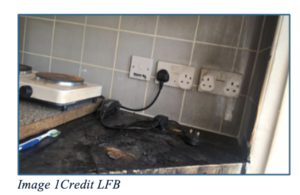
More than ten years after Croydon Council retrofitted sprinkler systems across its six extra-care housing complexes, a kitchen fire occurred originating from a cooker. The fire was effectively contained and extinguished by the activation of a single sprinkler head, eliminating the need for further firefighting, no injuries were reported.
In September 2015, the Fire Industry Association documented an earlier event at Truscott House one of Croydon’s extra-care housing complexes, where a kitchen fire caused by a toaster was successfully extinguished by the sprinkler system. The activation of the sprinklers prevented the fire from reaching the resident’s bedroom while he was asleep, thus ensuring his safety. The decision by Croydon Council to install sprinklers in all their extra-care housing facilities proved decisive in limiting the impact of these incident.
Conclusion
These collection of incidents reinforces why the BAFSA, The National Fire Sprinkler Network and the National Fire Chiefs Council has long advocated for the use of sprinklers in specialised housing and why, Government should follow the lead of Scotland and Wales expanding sprinkler requirements to include specialised housing.
Providing further supporting evidence to under pin BAFSA’s advocacy, turning operational evidence into persuasive tools for policy and parliamentary engagement, and reinforcing the case for wider sprinkler inclusion within national building policy.
In comparison the fire that burnt down the Beechmere extra-care retirement village in Crewe in August 2019 housing 132 apartments for some of our most vulnerable members of our communities, is a reminder on the danger of fires for this sector. No lives were lost but over 150 residents lost their homes.
Sprinklers were not fitted as it was not a statutory requirement under the building regulations.
Sources/further reading
- Sprinkler saves review 2025/25
- Sprinkler Saves winter review
- NFSN Newsletter
- Fire Industry Association, Care home fire sparks call for sprinkler systems
- ¹Coroners report to prevent future deaths
- 2An in-depth review of fire related fatalities and severe casualties in England, 2010/11 to 2018/19
- 3Research and analysis Fire Safety: Specialised housing and care homes
- News on the block, six years after Beechmere-The fire safety gap remains, BSA Tom Roche BSA
If you want to make a difference working in the fire sector, we need your assistance.
To make sprinklers the norm and not the exception – we need the evidence. Encouraging FRS and those in the sprinkler community to promote, collate, report sprinkler activations to Sprinkler Saves UK which will help to create a central and comprehensive record of fire incidents where sprinklers played their role in containing/controlling or extinguishing the fire.
If you hear of a save report it using this link.