- This event has passed.
Scotland Fulfilment Centre Saved By Sprinklers
1 November 2025 @ 8:00 am - 30 November 2025 @ 5:00 pm

Summary
Scottish Fire and Rescue Service (SFRS) reported a fire within a fulfilment warehouse about the size of 14 football pitches (93,000 square metres) involving a multi-tiered mezzanine structure. The fire was able to develop through openings in the structure, leading to a limited number of sprinklers operating on each level to control the fire. which was contained and controlled by the activation of the in-rack type automatic water suppression system. (AWSS) No injuries were reported.
The risks posed by these types of fires to firefighters should not be underestimated, as they often involve high storage density. This can lead to fires of such magnitude that it becomes impossible for firefighters to access the area and perform manual firefighting operations.
Research conducted by the National Fire Chiefs Council (NFCC) identifies that for firefighters to safely perform rescues from large storage warehouses a threshold limit of 4,000m2 is the limit to perform effective rescue. Demonstrating that the current threshold of 20,000m2 in England (Size of two football pitches) and 14,000m2 in Scotland must be lowered. (Reducing to 1,000m2 for warehouses containing hazardous goods.)
A sprinkler save (activation) is categorised as an event where one or more sprinkler heads have activated and contained, controlled, or, in some cases, extinguished a building fire. This review further substantiates the role and advantages of sprinkler systems within the built environment.
For this incident, the operation of the AWSS, inside the facility led to the following outcomes:
- Implementation of the premises emergency plan allowing the safe evacuation of staff from the premises which can accommodate up to 1200 staff members.
- Activation of the in-rack sprinkler system preventing horizontal fire spread.
- Reduced the rate of production of heat and smoke limiting fire growth and ultimately containing and controlling the fire.
- Limited the development of the fire, facilitating search and rescue efforts by firefighters and reducing risk to personnel.
- Averted the complete loss of the building due to fire.
- Prevented a potentially extended incident that could have required considerable resources from SFRS and impacted routine operations.
This incident provides additional evidence supporting the reliability and effectiveness of AWSS, aligning with findings from the report conducted by 1Optimal Economics and commissioned by the National Fire Chiefs Council and National Fire Sprinkler Network on the performance of sprinkler systems in controlling and extinguishing fires.
The incident
- SFRS despatched 4 pumping appliances to reports of a fire within a warehouse at 13:07.
- Upon arrival the incident commander established:
- That the seat of the fire was located on the first floor of the 4-storey mezzanine level.
- Which had spread to the ground, second, third and fourth level of the structure.
- Activating the premises sprinkler system.
- Firefighters equipped with breathing apparatus were committed to tackle the fire, extinguishing the fire using firefighting media, two jets.
- 4 sprinkler heads activated containing, controlling the fire preventing horizontal fire spread.
- The affected area damaged by fire covered approximately 10m² per floor.
- Stop message confirming the fire was all out received by SFRS control at 15:27 hours.
- Enquires are ongoing to identify the cause of the fire.
Conclusion
- This incident highlights the critical importance of active fire protection systems, notably in rack sprinkler systems, demonstrating their effectiveness minimising fire-related risks to people, property, and the environment.
- An event with the potential for significant escalation was resolved swiftly, resulting in minor disruption due to the effective operation of the sprinkler system.
- Incorporating sprinkler systems can safeguard assets, minimise financial loss, and bolster business resilience by controlling or extinguishing fires prior to the arrival of emergency services, allowing for rapid resumption of normal operations and mitigating economic and social impacts.
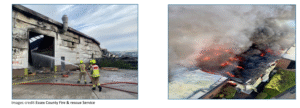
Essex non sprinklered warehouse fire
For context, the Business Sprinkler Alliance report that in in September 2025, a non-sprinklered 4000m2 warehouse was destroyed by fire. Requiring 90 firefighters, 12 fire appliances and specialist equipment from Essex County Fire & rescue Service to contain, control and extinguish the fire. The warehouse was shared by two businesses, the financial impact is unknown, but both companies will need to find alternative accommodation. The disruption to the business operations along with the destruction of stock is likely to come at a severe cost
BRE’s Cost benefit analysis
Research conducted by 2BRE Global in 2013 identified sprinklers to be cost effective fire suppression mechanisms in Warehouses larger than 2,000m2 (around half a football pitch in size)
The research also reported other benefits from installing sprinklers including, reductions in
- The costs of injuries and fatalities.
- Reductions in the CO2 released in fires.
- Reductions in C02 embodied in replacement of building contents and reconstruction of the building.
- Reductions in water used for firefighting.
- Reduction in unemployment caused by fires.
BAFSA Comment:
- We support the National Fire Chiefs Council position that Government should reduce the current threshold for the requirement of sprinklers within storage and warehouses to 4,000m2
Sources/further reading
- 1Efficiency and Effectiveness of sprinkler systems in the United Kingdom: An Analysis from Fire Service Data
- 2 An Environmental Impact and Cost Benefit Analysis for Fire Sprinklers in Warehouse Building, BRE Global, December 2013
- Sprinkler Saves Review 2024/25
- Sprinkler Saves winter update
- Business Sprinkler Alliance, case study Essex warehouse fire
- NFCC AWSS Policy Statement
- NFSN Winter newsletter
If you want to make a difference working in the fire sector, we need your assistance.
To make sprinklers the norm and not the exception – we need the evidence. Encouraging FRS and those in the sprinkler community to promote, collate, report sprinkler activations to Sprinkler Saves UK which will help to create a central and comprehensive record of fire incidents where sprinklers played their role in containing/controlling or extinguishing the fire.
If you hear of a save report it using this link.